


Bitcoin has been rising as the biggest asset in the 21st century and is already giving tough competition to Gold, Silver, and many other stocks in terms of valuation, demand, and usage. All these make investors wonder whether Bitcoin would be as valuable as it is today or exceed every asset by the middle of the century, i.e., 2050.
We expect Bitcoin to cross the $1 million mark by the end of 2050 based on sovereign (government) demand, the declining value of the US Dollar, the global gold shortage, and the lack of a true reserve currency untethered to politics.
Related: What Would Be The Price of Gold in 2050?
What is Bitcoin?
Bitcoin is the largest cryptocurrency created in 2008 in the wake of the Global Financial Crisis. It was launched on 3 January 2009 by mysterious cryptographer Satoshi Nakamoto. The core features of Bitcoin include decentralization, transparency, and anonymity, which allow anyone to transact very cheaply on it without exposing their personal information.
Definition
Bitcoin is a cryptocurrency and a blockchain that allows people to transact in BTC (the cryptocurrency) quickly and transparently without exposing their personal information. It runs on virtual machines created by pooling computational resources from all of its network participants (called nodes or miners).
Unlike fiat transactions, Bitcoin transactions are secure, transparent, and immune to server crashes due to decentralization. Further, with Bitcoin, you can send funds from one account to another in minutes, anywhere in the world.
All of these helped Bitcoin increase its popularity among people who found fiat transactions too costly, were worried about the declining value of their currency, and needed a medium of transfer that was more anonymous than the traditional ones.
Why do People Care About Bitcoin’s Price?
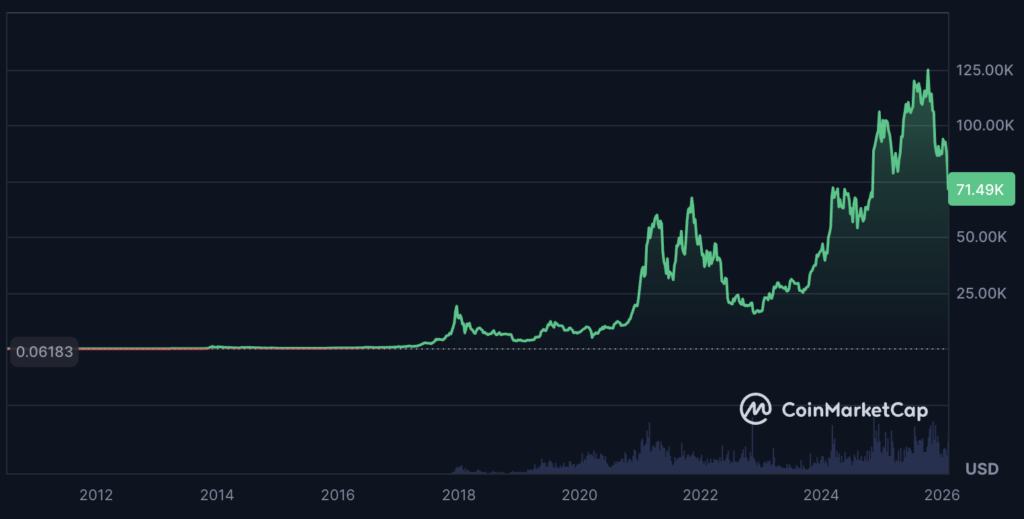
Bitcoin started with a price of less than a cent. On 22 May 2010, programmer Laszlo Hanyecz bought 2 pizzas for $40 with 10,000 Bitcoins, making it the first successful real-world cryptocurrency transaction.
Since then, the price of Bitcoin has risen to $126,000 in October 2025, and despite crashes and price falls, it continues to grow higher every cycle.
Bitcoin has been the best-performing asset in the world since its creation in 2009 which contributes to its high demand. Below is the price history of Bitcoin from 2009 to 2026.

Why is Predicting Bitcoin’s Price so Uncertain?
Bitcoin is a cryptocurrency, which is the most volatile asset among all financial spot market assets, including stocks, precious metals, bonds, commodities, and non-derivatives.
It is also impacted by several other factors that do not impact traditional assets, such as an always-open market, perpetual spot trading, easy transfers between countries, and its status as a quasi-reserve currency.
As a result, predicting the price of Bitcoin has always been one of the toughest challenges.
For example, in early 2026, most economic factors like inflation, interest rates, and global trade have been somewhat stable, giving a solid boost to equity markets. At the same time, Bitcoin took a nosedive from $126k in October 2025 to $70k in February 2026.
What do we do differently to Achieve Accuracy?
We judge Bitcoin’s price on the basis of so many factors, such as:
- retail demand
- government demand
- corporate demand
- market supply
- outstanding future contracts in the market
- analyze call options with max pain
- track perpetual market funding rates
- technical charts to see whether there is any mathematical correction upcoming
- talk with real market participants using surveys
Factors That Will Shape Bitcoin’s Future till 2050
We had shortlisted over a hundred factors; however, most had negligible effects on Bitcoin’s price. Presenting you with the most impactful ones.
Please note that this list is updated frequently and might see major changes with their impact increasing or decreasing.
Adoption and Demand
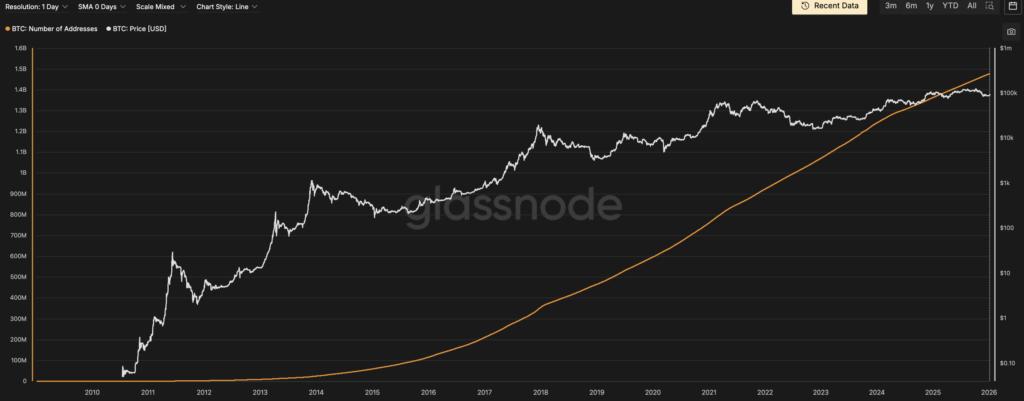
In the last decade, Bitcoin has seen a rapid pace of adoption. From being just a small, obscure cryptocurrency, it now commands a multi-trillion-dollar market cap. The demand for Bitcoin has been rising from just 70,000 users in 2010 to over 1.5 million users in early 2026.
Below is a graph from Glassnode depicting the same.

Regulation and Government Policy
Government policy on Bitcoin matters a lot in driving or curtailing its adoption. A pro-Bitcoin government helps grant Bitcoin legality and therefore adoption, while an anti-Bitcoin policy negatively impacts its price.
The UAE presents an example of a pro-Bitcoin government policy with 0% tax, whereas much of Europe shows a negative policy with taxation up to 46%.
Technology and Development
Any technology needs continuous evolution to remain relevant, and the same is true for Bitcoin. Technological developments such as the Lightning Network helped keep Bitcoin transactions cost-effective even after the launch of cheaper blockchains.
Another example is the creation of Bitcoin Ordinals, which gave Bitcoin some support to compare with Ethereum’s NFTs.
The next major upgrade in Bitcoin is expected to be quantum resistance, which would nullify the threats of quantum computers decoding wallet passwords from their addresses.
Scarcity and Supply Dynamics
Bitcoin’s supply is fixed at 21 million, of which nearly 20 million have already been mined, and 1 million is expected to be mined by 2140. So the supply in the market is constant.
The main price driver here is demand. High demand from sources such as Bitcoin Treasuries, Whales, Governments, and retail markets (including ETFs) can impact its price from time to time.
Peer Competition
Bitcoin has several substitutes, such as Ethereum, XRP, and Solana, which affect its demand. If the price of Bitcoin rises too high, investors turn to these substitutes. However, due to market cycles, these substitutes get affected too, and as a result, Bitcoin gets stronger in those times.
There is an index to track whether Bitcoin dominates all its substitutes (which is mostly the case) or if the opposite is true. This index is called the Altcoin season index; a score closer to 100 indicates weak Bitcoin demand, and a score closer to 0 indicates strong demand.
Below is the graph of the altcoin season index over the last 1 year.
Possible Scenarios
We have analyzed two possible scenarios for Bitcoin’s price in 2050, based on the best and worst conditions. Bitcoin is expected to stay between these prices.
Bullish Case
In the most bullish case, Bitcoin could cross $5 million price tag by 2050 based on:
- government adoption as a currency reserve
- corporate adoption to back their treasuries
- retail demand as a core financial asset
- demand as an efficient and secure mode of funds transfer
Moderate Case
A moderate case assumes Bitcoin to trade between $1 million and $5 million and assumes any one or more of the above mentioned factors work.
Bearish Case
In the bearish case, we expect all these demands wane, and there is only a fractional retail demand that fits the use case of Bitcoin as a private mode of funds transfer.
Frequently Asked Questions
How Bitcoin’s Role in the World Could Look in 2050?
We see Bitcoin as a Reserve Financial Asset by 2050, used by Central Banks and Governments to replace US Dollars, Euros, and other currencies, and to substitute Gold (due to scarcity). In the retail market, we see Bitcoin as a primary component of serious investors’ portfolios, including spot BTC and ETFs.